HomeAboutThe InstituteProject OverviewBlogEndorsementsSupport UsJoin Our CommunityBooks
Discover the Hybrid Model Explore the Vision Video Greening Energy Green Yield News Founding Directors Contribute →
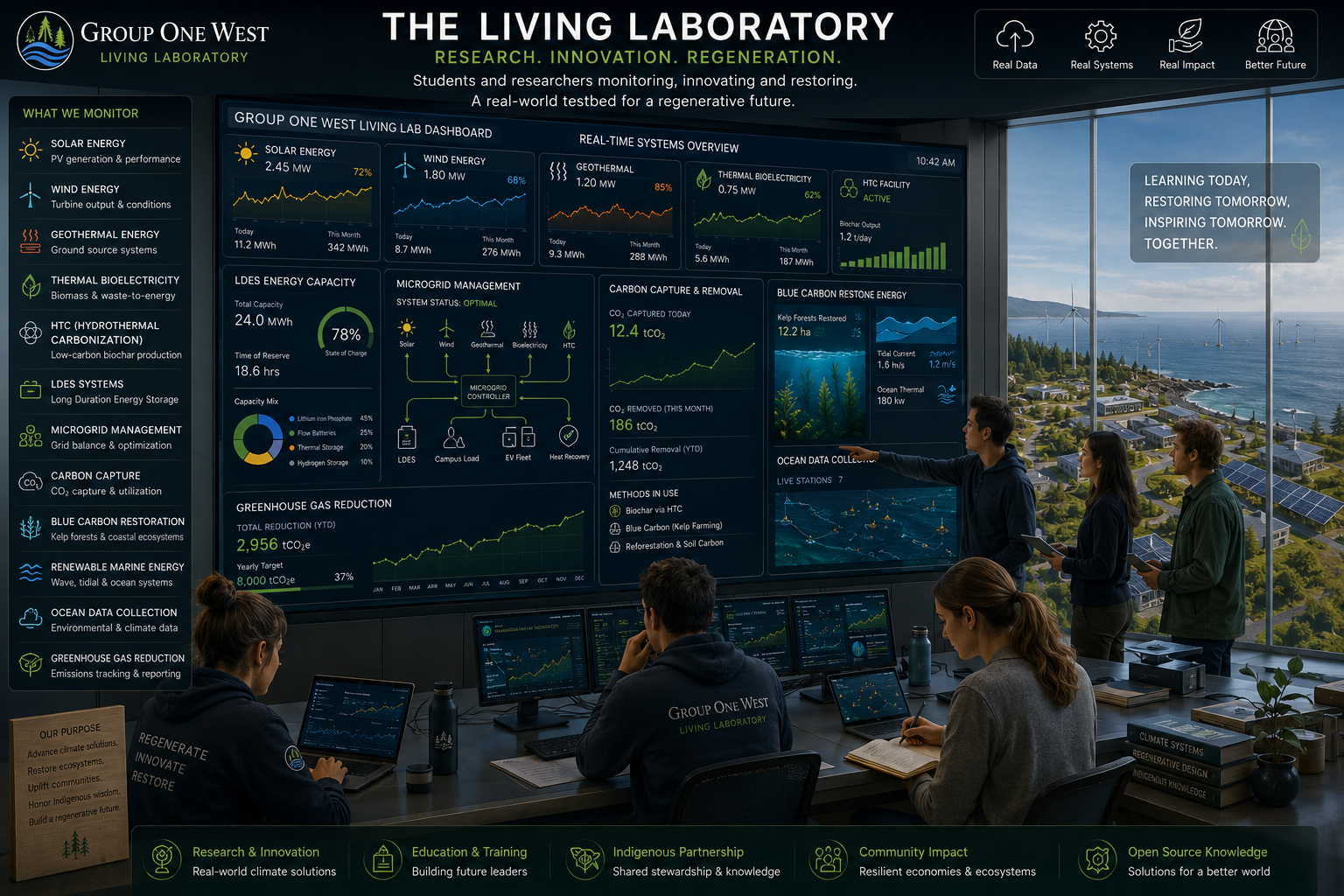
Concept of the Living Discovery Lab on Vancouver Island
The Group One West Institute for Climate Research and Cultural Stewardship

Good ideas, tested together, in real life.

We are a non-profit society in British Columbia working to create a place on Vancouver Island where climate solutions are proven in daily life, guided by Indigenous knowledge and science together, and shared openly with everyone.

Why it matters

Many good climate solutions never leave the laboratory.

Canada is strong at research but weaker at putting research to use. A new solar panel, a better building material or a smarter greenhouse can work perfectly in a test room and still never be adopted, because no one has seen it work alongside everything else, in a real place, through a real winter.

1.8% vs 2.7%

Canada's research and development spending as a share of the economy in 2023, against the OECD average.

OECD Economic Survey of Canada, 2025
1% vs 2%

Business research and development, the part most tied to productivity, against the OECD average.

OECD Economic Survey of Canada, 2025
17% vs 47%

Venture capital's share of all private capital in 2023, against its share of climate investing. The money runs short exactly where pilots must become real projects.

True North Institute

That missing step is costly. Vancouver Island depends on the mainland for most of its electricity, food prices keep rising, and climate damage keeps growing. The answers we need already exist in pieces. What is missing is a place to put the pieces together and prove they work.

60%

of Vancouver Island's electricity arrives from the mainland by undersea cable. The province expects power demand to rise 20% within four years.

Castanet; BC Gov News
1 in 4

people in the provinces faced some level of food insecurity in 2024, and food prices are 27% higher than five years ago.

Statistics Canada via Calgary Journal; Arrell Food Institute
$37B

in insured losses from severe weather and wildfires in 2016 to 2025, nearly triple the $14 billion of the decade before.

Insurance Bureau of Canada
The Institute exists to be that place: not to compete with universities and industry, but to give their best ideas somewhere to be tested, together, under real conditions.
What we do

The Living Discovery Lab

Our vision is a working coastal campus where energy, buildings, food, water and daily operations run as one system, and every part of it can be studied, improved and learned from.

Test it

Clean energy from sun, wind, wave and tide, low-carbon buildings and year-round local food, tested together under real use.

Show it

Live dashboards, tours and open data, so guests, researchers and the public can see what works and what doesn't.

Teach it

A living classroom for students of every age, here and, through live streaming, in classrooms far beyond the Island.

How we work

Relationships come before development.

Respect

Indigenous Knowledge and Western Science, in respectful partnership. Where Indigenous lands, waters or knowledge are involved, nothing goes ahead without free, prior and informed consent.

Honesty

We will share what fails as openly as what succeeds.

Openness

What we learn belongs to everyone who can use it, so other communities can adapt it to their own places.

Future generations

Every decision should leave the land, the water and the community better than we found them.

Where we are

The Institute was registered in December 2025 and is guided by its directors, an Advisory Panel and twelve university capstone studies. The Living Discovery Lab is still a plan. We have not chosen a site, and we have no First Nations partnership; we hope to earn one through listening and trust. Our next step is Phase 2: creating the best plan for the project and setting the priorities for its development, before anything is built.

Help us take the next step.

Early support goes furthest. It helps turn a well-researched vision into proof.

Two ways to contribute

Contribute directly.

Give any amount you choose to support the Institute's work.

Choose an e-book.

Make a contribution of whatever you can give, and receive any of Sam Kirsch's e-books as our thank-you: One More Chair (or its Young Readers' Edition for ages 9 to 12), Nothing Was Ever Hidden, The Last Dividend or Electricity Out of Thin Air. You set the price.

Please note: the Institute is a registered non-profit society in British Columbia but has not yet completed its registration with the Canada Revenue Agency, so we cannot issue receipts for income tax purposes. Tax-deductible receipts will not be available until we complete our registration with the CRA.

Sources

  • OECD, Economic Surveys: Canada 2025
  • True North Institute, How first-of-a-kind projects get financed
  • Castanet, Province acquires Campbell River power plant
  • BC Gov News, BC Hydro to acquire Island Generation
  • Arrell Food Institute, Canada's Food Price Report 2026
  • Calgary Journal, food insecurity and the 2026 Food Price Report (Statistics Canada data)
  • Insurance Bureau of Canada, 2025 insured losses